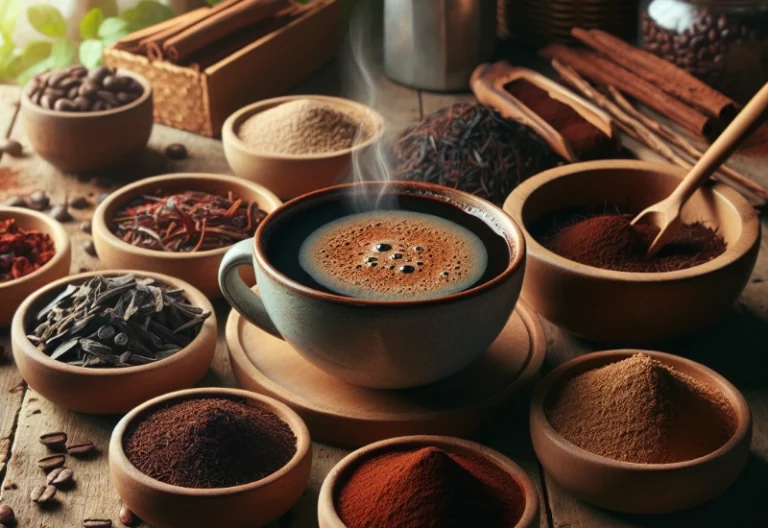
7 Hot Coffee Alternatives (With Recipes)

Contents
- 1 Chai Tea: A Spiced Tea Blend
- 2 Matcha Latte: Japanese Green Tea Powder
- 3 Golden Milk: Hot Morning Alternative To Tea And Coffee
- 4 Yerba Mate: Herbal Tea from South America
- 5 Rooibos Tea: Caffeine-Free Herbal Tea
- 6 Dandelion Coffee: Hot Morning Drink To Replace Coffee
- 7 Spiced Hot Chocolate: Decadent Hot Chocolate
- 8 Conclusion
If you like having something hot in your hands in the morning but want a break from coffee, these seven hot coffee alternatives are worth a try. Three still have caffeine (chai, matcha and yerba mate), and four have none or almost none (golden milk, rooibos, dandelion coffee and hot chocolate, which has only a little). Each comes with a simple recipe. For a broader overview, see our guide to the world of hot coffee alternatives.
Chai Tea: A Spiced Tea Blend
Masala chai is black tea simmered with milk and spices, and it’s been a staple in India for generations. The usual spices are cardamom, cinnamon, ginger, cloves and black pepper, though every household has its own mix. It’s warming, sweet and a bit peppery, and it has about half the caffeine of a cup of coffee. Ginger and cinnamon are often credited with helping digestion. That’s a nice bonus, but the main reason to drink chai is that it tastes good.
For one large mug:
- Put 1 cup of water, 2 teaspoons of loose black tea (or 2 bags), 3 lightly crushed cardamom pods, a small piece of cinnamon stick, a few slices of fresh ginger, 2 cloves and a couple of peppercorns in a saucepan.
- Bring it to a boil, then simmer for 3 to 5 minutes. The longer it goes, the stronger the spices.
- Add 1 cup of milk and sugar or honey to taste, and bring it back up to a simmer.
- Strain into a mug.
Matcha Latte: Japanese Green Tea Powder
Matcha is green tea ground into a fine powder. Because you drink the whole leaf instead of steeping and discarding it, you get more caffeine and antioxidants than you would from regular green tea. A cup has roughly half to two-thirds the caffeine of coffee. It also contains L-theanine, which is why many people find matcha gives them a calmer, steadier kind of alertness. The taste is grassy and a bit bitter, and milk smooths it out.
For one latte:
- Sift 1 teaspoon of matcha into a bowl and whisk it with 2 tablespoons of hot (not boiling) water, about 175°F (80°C), until smooth and frothy. Boiling water makes it bitter.
- Heat and froth about 3/4 cup of milk, then pour it over the matcha.
- Stir, and sweeten if you like.
Some of matcha’s reputation is deserved and some is hype:
- Antioxidants: Matcha is high in catechins, the main antioxidants in green tea. This part is well established.
- Calm focus: The combination of L-theanine and caffeine is the most convincing reason to choose it over coffee. Most people report less of a jittery edge.
- Metabolism: Green tea extracts have a small effect on metabolism in some studies. A daily latte won’t make a noticeable difference to your weight.
Variations are easy:
- Matcha Iced Latte: Whisk the matcha with water as above, then pour it over ice and cold milk.
- Matcha Frappe: Blend matcha, milk, ice and a little sweetener until thick.
- Matcha Latte with Flavored Syrups: A small amount of vanilla works well. Caramel and hazelnut can overwhelm the tea, so use them sparingly.
Golden Milk: Hot Morning Alternative To Tea And Coffee
Golden milk, also called a turmeric latte, is warm milk with turmeric and spices. It’s been drunk in India for a long time as haldi doodh, often as a home remedy for colds. It’s caffeine-free, so it makes a good morning drink alternative to tea and coffee, and it works just as well before bed.
The taste is earthy and a bit peppery, softened by the milk and a little sweetener. For one mug, warm 1 cup of milk (dairy or plant) with 1/2 teaspoon of ground turmeric, a pinch of black pepper, 1/4 teaspoon of cinnamon and a few slices of fresh ginger. Simmer gently for a few minutes, sweeten with honey or maple syrup, and strain.
A few notes:
- Health: Turmeric contains curcumin, which has anti-inflammatory properties in lab studies. The amount in one drink is small, and curcumin isn’t absorbed well on its own. Black pepper helps with absorption, which is why it’s in the recipe.
- Tradition: Turmeric milk has long been used in Ayurveda, India’s traditional medicine system.
- Variations: Add more ginger for heat, or cardamom and nutmeg for a more chai-like flavor. Coconut milk makes it richer.
- Shortcuts: Make a turmeric paste ahead of time by simmering turmeric, pepper and water until thick. Keep it in the fridge and stir a spoonful into hot milk. A milk frother makes it smoother.
Turmeric stains everything it touches, so be careful with your countertops and white mugs.
Related: Are you interested in 7 DIY Iced Coffee Alternatives?
Yerba Mate: Herbal Tea from South America
Yerba mate is made from the dried leaves of a holly plant native to South America. The Guaraní people drank it long before Europeans arrived, and it’s still the everyday drink in Argentina, Uruguay, Paraguay and southern Brazil. It tastes grassy, smoky and bitter, a bit like a strong green tea.
Yerba mate is the strongest option on this list for caffeine, so don’t treat it as a gentle swap:
- Caffeine: A cup has roughly as much caffeine as a weak to medium coffee, plus small amounts of theobromine (the stimulant in chocolate). Some people find it smoother than coffee, but it can still cause jitters and keep you awake.
- Antioxidants: It’s high in polyphenols, much like green tea.
- Focus: You get coffee-like alertness, which is the whole point for most drinkers.
Making it:
- Fill a gourd (or a mug) about halfway to two-thirds with yerba mate leaves.
- Pour in hot but not boiling water, around 160-180°F (70-80°C). Boiling water makes it harsh.
- Let it steep for 3 to 5 minutes if you’re using a mug and a strainer. With a gourd, you sip through a filtered straw (bombilla) and keep topping up the water.
- Drink it plain, or add a little honey or a slice of orange.
Rooibos Tea: Caffeine-Free Herbal Tea
Rooibos, or red bush tea, comes from a shrub that grows only in the Cederberg area of South Africa’s Western Cape. It brews a deep reddish-orange and tastes naturally sweet and a bit woody, with a hint of vanilla. It’s completely free of caffeine, so you can drink it in the evening.
Rooibos contains antioxidants, including aspalathin, which is found almost only in rooibos. It’s also low in tannins, so it doesn’t turn bitter if you steep it too long. That makes it hard to get wrong and good with milk, which is how many South Africans drink it.
To make it:
- Boil fresh water. Rooibos can handle it, so there’s no need to let it cool much.
- Put a tea bag or 1 to 2 teaspoons of loose rooibos in a mug or teapot.
- Pour the water over it.
- Steep for 5 to 7 minutes. You can go longer for a stronger cup.
- Remove the bag or strain, and add milk and honey if you like.
Dandelion Coffee: Hot Morning Drink To Replace Coffee
Dandelion coffee is made from roasted dandelion roots. It’s caffeine-free and the closest thing on this list to the taste of coffee: dark, bitter and earthy, with a slight caramel note from the roasting. Dandelion root is sometimes said to support digestion, but there’s very little human research to back that up.
You can buy it ready-roasted, or make it yourself from roots you dig up:
- Dig roots only from places you know haven’t been sprayed with herbicides or pesticides. Avoid roadsides.
- Scrub the roots well. Soaking them for a few minutes first helps loosen the soil.
- Chop them into small, even pieces, about the size of a pea.
- Dry them completely, either in the air for a few days or in a low oven or dehydrator. Damp roots can go moldy.
- Roast them on a tray at about 350°F (175°C), stirring every so often, until they’re dark brown and smell roasty. Expect this to take around half an hour or more. Watch them toward the end so they don’t burn.
- Let them cool, then grind them in a coffee grinder.
- Use about 1 tablespoon per cup. Simmer it in water for 5 to 10 minutes, then strain. Milk and a little honey help with the bitterness.
Dandelion is in the same plant family as ragweed, so try a small amount first if you have that allergy.
Spiced Hot Chocolate: Decadent Hot Chocolate
Hot chocolate isn’t a health drink, but it’s a perfectly good coffee replacement on a cold afternoon. Cocoa contains a little caffeine and some theobromine, so you get a mild lift. Spices make it more interesting and less sweet-tasting. For one mug:
- Heat 1 cup of milk in a saucepan. Whisk in 1 to 2 tablespoons of unsweetened cocoa, 1 to 2 teaspoons of sugar and a pinch of salt.
- Add 1/4 teaspoon of cinnamon, a grating of nutmeg and a very small pinch of cayenne. Keep whisking over low heat until it’s smooth and steaming.
- Pour into a mug. Taste and add more sugar or cayenne if you want.
Conclusion
If you want to cut caffeine but not lose it entirely, chai or a matcha latte is the easiest switch. Yerba mate is for people who still want a proper kick. For no caffeine at all, rooibos is the simplest option and dandelion coffee comes closest to the taste of coffee. Golden milk and spiced hot chocolate are better as evening drinks than morning ones. Try two or three for a week each and see which ones stick.